
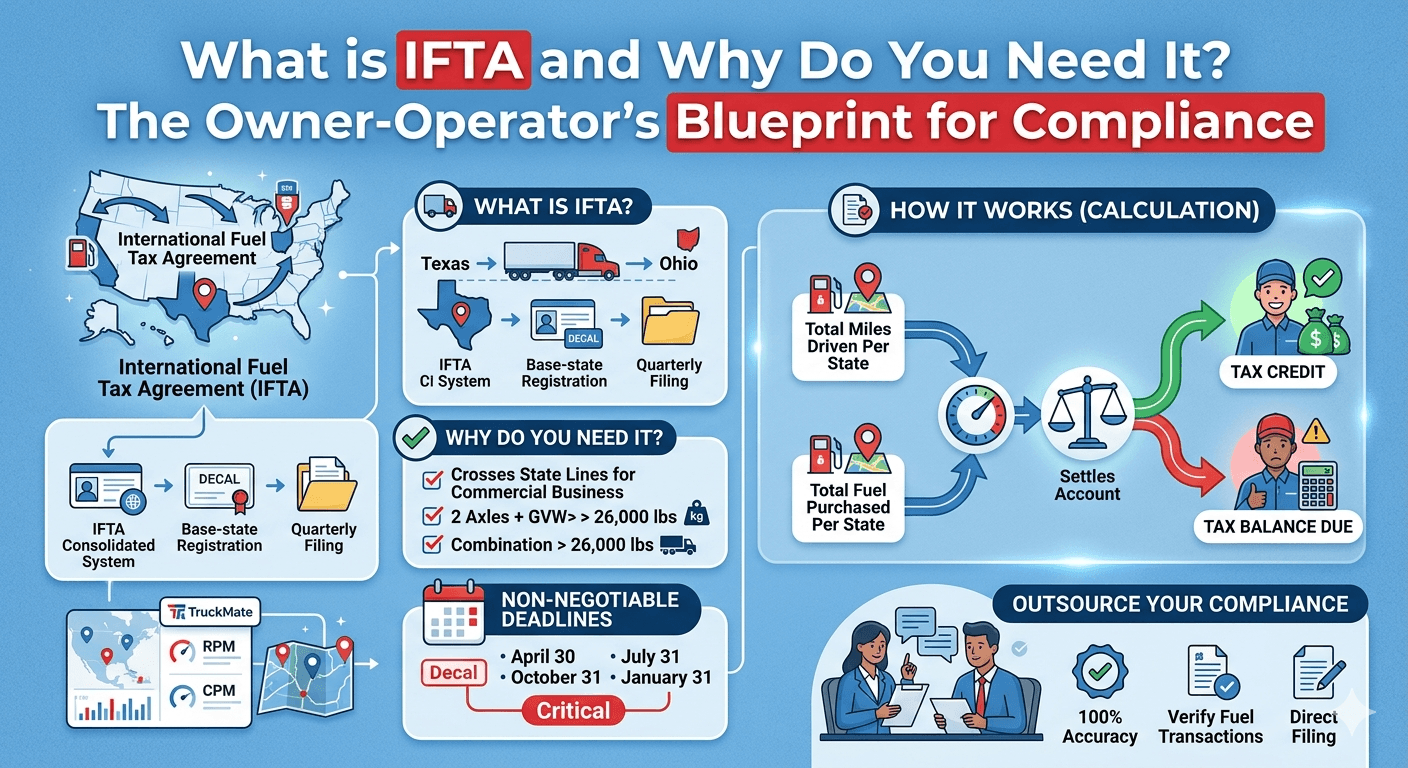
What is IFTA and Why Do You Need It? The Owner-Operator's Blueprint for Compliance
For owner-operators and small fleet owners, managing federal regulations can feel like a full-time bottleneck. Between keeping track of your logs, negotiating with brokers, and keeping your equipment moving, you do not have time to get buried in complex tax formulas.
Operating a qualified motor vehicle across state lines makes managing the International Fuel Tax Agreement (IFTA) mandatory. Mistakes or delayed filings will lead to heavy audit penalties, interest charges, or direct suspension of your operating authority.
This breakdown details exactly what IFTA requires, why your operation needs it, how the calculations work, and how to hand off your quarterly compliance so you can focus entirely on driving.
What is IFTA?
The International Fuel Tax Agreement (IFTA) is a cooperative agreement between the lower 48 states of the United States and 10 Canadian provinces. Before IFTA, carriers had to purchase individual fuel tax permits for every single state they traveled through, creating an expensive administrative mess of paperwork and countless tax decals.
IFTA consolidated this process into a centralized system. Under this agreement, your fleet registers strictly in your "home jurisdiction" (the state where your business is base-registered). You receive a single IFTA license and two decals for your truck, granting clearance across all participating states and provinces. At the end of every quarter, you file one comprehensive fuel tax report with your base state to settle your account.
Why Do You Need IFTA? (Who Qualifies?)
If you operate an interstate commercial vehicle, you are legally required to obtain a USDOT number along with an MC number, maintain active registration, and file quarterly reports if your equipment meets the definition of a qualified motor vehicle.
Your vehicle must be registered under IFTA if it crosses state lines to conduct commercial business and matches any of the following criteria:
- It has two axles and a gross vehicle weight (GVW) or registered gross vehicle weight exceeding 26,000 pounds.
- It has three or more axles, regardless of the truck's weight.
- It is used in combination, and the combined GVW or registered GVW of the power unit and trailer exceeds 26,000 pounds.
⚠️ Critical Status Note: Operating strictly within your home state borders means you do not need an IFTA license. However, the exact moment your wheels cross a state line for commercial purposes, you must either be registered or purchase an expensive temporary fuel trip permit for that specific state. You must also ensure your UCR registration remains active.
How Does IFTA Calculation Work?
The operational logic behind IFTA is direct: States demand tax revenue for fuel consumed on their roads, no matter where that fuel was actually purchased.
When you buy diesel at the pump, the state tax is automatically included in the purchase price. If you buy 300 gallons of diesel in Texas but run the majority of your miles across Ohio, Texas pockets that tax revenue even though Ohio's roads took the wear and tear.
Your quarterly IFTA filing balances the scales by cross-referencing your operational data:
- Total Miles Driven: The exact distance accumulated in each individual state.
- Total Fuel Purchased: The precise gallons of diesel bought in each state.
- Average Fuel Consumption (MPG): Your total fleet miles divided by total gallons purchased.
- Fuel Consumed Per State: The actual miles driven in a specific state divided by your calculated average MPG.
If you paid more tax at the pump in a specific state than the amount of fuel you actually burned there, you receive a tax credit. If you consumed more fuel in a state than you bought there, you owe a tax balance.
Managing this data manually requires flawless trip logs and receipt audits. To see how these numbers impact your actual overhead, look at our breakdown on how to calculate trucking Cost Per Mile (CPM).
Non-Negotiable IFTA Filing Deadlines
IFTA reports must be submitted four times a year. Missing these specific dates results in automatic fines—usually $50 or 10% of the tax due, whichever is greater—and immediately marks your USDOT number as a high-risk target for a DOT audit.
| Quarter | Period Covered | Filing Deadline |
|---|---|---|
| 1st Quarter | January 1 – March 31 | April 30 |
| 2nd Quarter | April 1 – June 30 | July 31 |
| 3rd Quarter | July 1 – September 30 | October 31 |
| 4th Quarter | October 1 – December 31 | January 31 |
Costly IFTA Compliance Traps to Avoid
Failing to secure your records can lead to thousands of dollars in back taxes and penalties during an audit. The most frequent operational failures include:
- Odometer Gaps: Missing mileage records between loads or failing to log off-duty personal conveyance miles.
- Unverified Fuel Receipts: If you lose a receipt, auditors will disallow that pump transaction completely, forcing you to pay the state tax a second time out of pocket. Always link purchases to a corporate EIN number to build a clear audit trail.
- Failing to File Zero-Activity Reports: If your truck sits idle for a quarter and runs zero miles, you must still file a "Zero Report" on time to keep your credentials active.
Outsource Your Fleet Compliance: We Handle Your IFTA Filings
You did not get into the transportation industry to spend your time auditing receipts and filling out tax forms. Protecting your FMCSA compliance requirements should not drain the energy you need to run your business.
At Trucking Help Center, our expert team takes the compliance burden completely off your shoulders. We audit your raw data, calculate your exact state-line mileage splits, verify every fuel transaction, and execute the filing directly with your home jurisdiction to guarantee 100% accuracy. We also manage your complete BOC-3 filing setup and manage the steps on how to file a BOC-3 for your MC authority quickly.
Maximize Margins with TruckMate
To take control of your revenue tracking, Zeshan Danish, the founder of Trucking Help Center, engineered TruckMate—the ultimate operational system for carriers.
TruckMate is an all-in-one mobile system built to eliminate manual business management. With TruckMate, you can:
- Centralize Expense Management: Track fuel, maintenance overhead, and administrative costs seamlessly.
- Monitor Live RPM and CPM: View your exact Revenue Per Mile versus Cost Per Mile instantly to secure your margins on every dispatch.
- Run Direct FMCSA Broker Verifications: Protect your truck from fraud by auditing broker safety records, credit scores, and bond authority before booking freight. Never get stuck dealing with a broker not paying for a load again.
📥 Take control of your operations. Download the TruckMate application directly from the Google Play Store: Download TruckMate on Google Play
Elite Freight Dispatching Solutions
While our compliance team protects your authority, our elite dispatching division keeps your equipment loaded with top-paying freight. We offer aggressive, clear corporate pricing structures designed to scale your cash flow:
- $250 Flat Weekly Rate OR
- 5% Per Load Managed
We negotiate directly with shippers and brokers, execute credit approvals, handle carrier onboarding packets, integrate with your freight factoring company infrastructure, coordinate specialized credentials like a TWIC card, and issue your Certificates of Insurance (COI) so your focus stays strictly on moving trucks.
Secure Your Compliance Today
Do not let administrative deadlines jeopardize your authority or slow down your fleet's momentum. Whether you need an expert team to file your current IFTA report, elite dispatch support, or want to deploy TruckMate to automate your tracking, the Trucking Help Center has the expertise to execute it.
Contact Our Experts:
- Call/Text: 469-942-5988
- Email: Send your MC Letter or current fleet requirements directly to support@truckinghelpcenter.com
- Review Fleet Blueprints: Master the exact operational steps required to scale by reading our blueprint on how to become a successful owner-operator.