
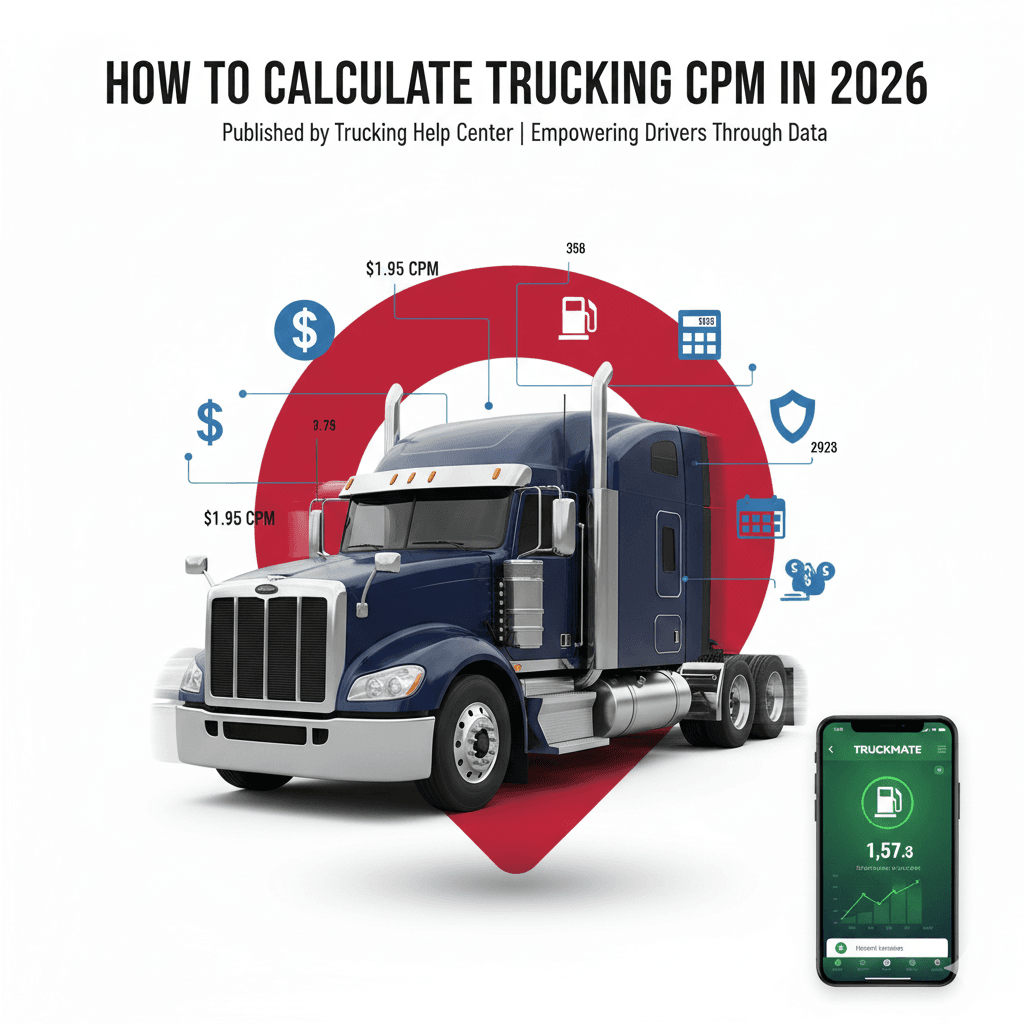
Published by Trucking Help Center | Empowering Drivers Through Data
Knowing your Cost Per Mile (CPM) is the difference between being a successful fleet owner and an out-of-work driver. In 2026, with shifting fuel prices and rising insurance, "guessing" your profit is a recipe for bankruptcy.
This guide breaks down exactly how to calculate your CPM, how to use it to crush broker negotiations, and how our upcoming TruckMate app is automating this entire process for you.
1. What is Cost Per Mile (CPM)?
CPM is the total cost to move your truck exactly one mile. It includes everything from your truck payment to the EIN Number you used to set up your business.
The Brutal Truth: If you don't know your CPM, you aren't running a business—you're running an expensive hobby. To stay profitable, you must track every expense tied to your MC Number and DOT Number.
2. The Formula: Fixed vs. Variable Costs
To find your true CPM, you must separate your costs into two buckets:
Fixed Costs (The "Sit Still" Bills)
These expenses happen even if the truck doesn't move a single inch.
- Truck/Trailer Payments
- Insurance: Your COI (Certificate of Insurance) is a major fixed cost.
- Compliance Fees: Annual UCR Registration and BOC-3 Filing fees.
- Operating Authority: Maintaining your Permits and Authority.
Variable Costs (The "Rolling" Bills)
These costs increase every time the wheels turn.
- Fuel: Your biggest enemy.
- Maintenance: Tires, oil, and repairs.
- Driver Pay: Whether it's you or an employee.
- IFTA: Taxes paid on fuel consumption across state lines. Learn about IFTA here.
3. The Deadhead Mile Trap
Many drivers calculate CPM based only on "loaded" miles. This is a fatal mistake. Your truck wears down and burns fuel during "deadhead" miles (driving empty to a pickup).
The Math: Total Expenses ÷ (Loaded Miles + Deadhead Miles) = True CPM
If you are a driver with a TWIC Card, you may have access to high-paying port loads that reduce your deadhead, but you still must account for every unpaid mile.
4. Cash Flow and Factoring
Managing your CPM is impossible if you’re waiting 30–60 days for a check. This is why many successful operators use Trucking Factoring to get paid within 24 hours. While factoring carries a small fee, it provides the "liquid" cash needed to cover your variable costs like fuel and repairs.
5. Using CPM as a Negotiation Weapon
When a broker offers you a load, don't just look at the total price. Compare it to your CPM.
- Broker Offer: $2.10/mile
- Your CPM: $1.95/mile
- Profit: $0.15/mile
If that profit doesn't cover your time, walk away. You can’t negotiate effectively with the FMCSA or brokers if you don't know your "walk-away" number.
6. Meet TruckMate: Your CPM Co-Pilot
We know that manually calculating CPM every week is a headache. That’s why we are developing TruckMate.
TruckMate is a mobile application designed specifically for owner-operators to:
- Auto-Track Expenses: Link your fuel cards and maintenance receipts.
- Real-Time CPM: See your exact cost per mile as you drive.
- Profitability Filter: Instantly see if a load is worth taking before you call the broker.
7. Need Help? Contact Us
At Trucking Help Center, we are dedicated to keeping drivers on the road and profitable. Whether you need help with compliance, understanding your numbers, or getting early access to the TruckMate app, our team is ready to support you.
Contact Details:
- Phone: 469-942-5988
- Email: Support@truckinghelpcenter.com
- Website: www.truckinghelpcenter.com
Don't just drive—operate. Master your CPM and take control of your business today.