
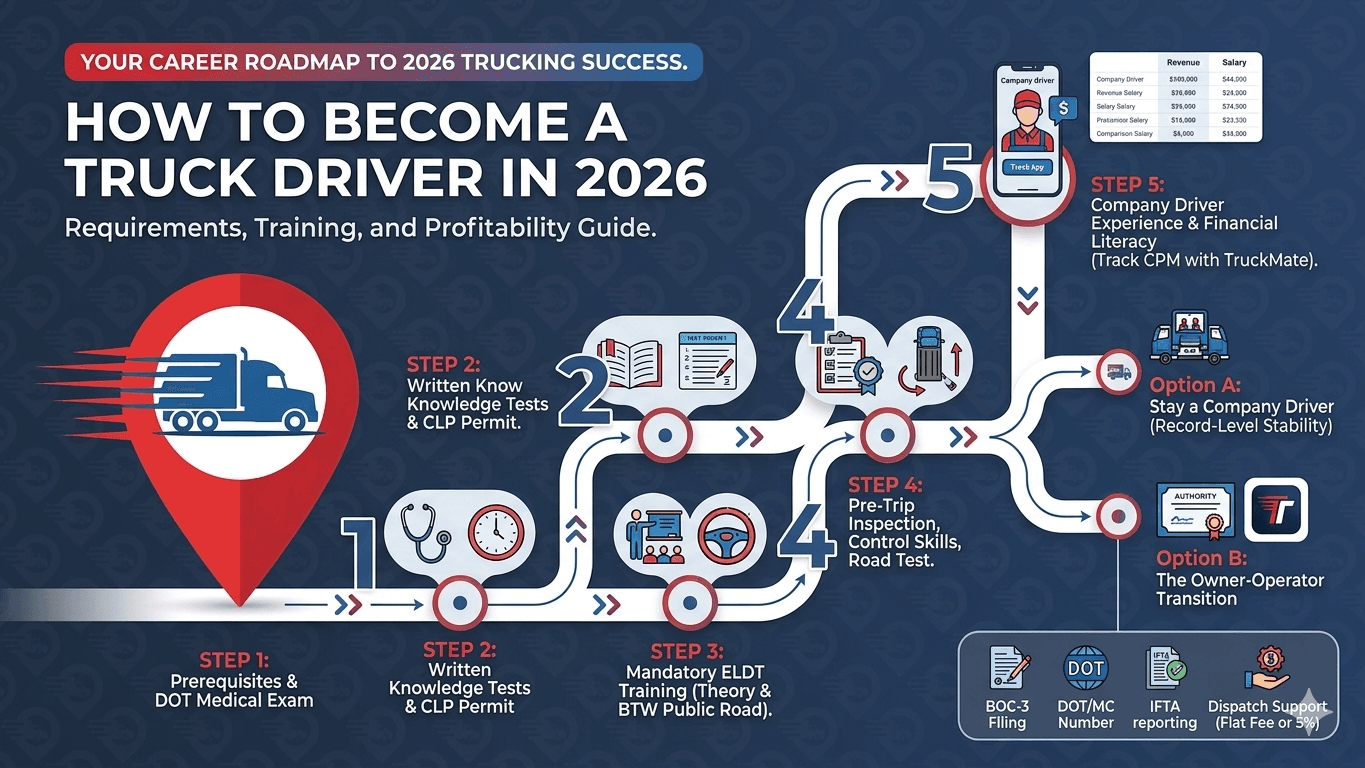
How to become a truck driver in 2026 CDL requirements 2026, ELDT training, entry-level driver training, truck driver salary 2026, how to get a commercial driver's license, owner-operator career path.
To become a truck driver in 2026, you must obtain a Commercial Driver’s License (CDL) by meeting federal and state requirements. The process involves passing a DOT medical exam, obtaining a Commercial Learner’s Permit (CLP) by passing written knowledge tests, and completing mandatory Entry-Level Driver Training (ELDT) from a provider listed on the FMCSA Training Provider Registry. After completing the theory and behind-the-wheel training, you must pass a three-part skills test including a pre-trip inspection, basic vehicle control, and a road test. In 2026, successful drivers also utilize technology like the TruckMate app to track profitability and understand their Cost Per Mile (CPM) from day one.
How to Become a Truck Driver in 2026: The Ultimate Career Roadmap
The trucking industry is the backbone of the American economy. In 2026, the demand for skilled, professional drivers is higher than ever, but the barriers to entry have become more sophisticated. It is no longer just about "learning to drive a big rig"—it is about becoming a certified professional who understands safety, technology, and business profitability.
If you are looking to enter the industry, you need a clear map. Whether your goal is to stay a company driver or eventually become a successful owner-operator, the foundation you build today determines your paycheck tomorrow.
Step 1: Understanding the Prerequisites
Before you visit a DMV or sign up for a school, you must meet the federal baseline established by the FMCSA.
Age and Residency
To drive within your state lines (Intrastate), you must be at least 18 years old. To drive across state lines (Interstate), which is where the majority of long-haul opportunities exist, you must be 21. You also need a valid non-commercial driver’s license and proof of legal residency. If you plan to eventually set up your own trucking business, you will also need to secure an EIN Number for tax purposes.
The DOT Physical
The Department of Transportation requires every commercial driver to be medically fit. You must pass a physical exam conducted by a certified medical examiner. They will check your vision, hearing, blood pressure, and look for underlying conditions like sleep apnea or diabetes that could interfere with safe driving.
Step 2: Obtaining Your Commercial Learner’s Permit (CLP)
Think of the CLP as your "training wheels." You cannot get behind the wheel of a Class 8 truck without it. To earn your CLP, you must pass three core written exams:
- General Knowledge: Covers basic safety, cargo handling, and vehicle inspection.
- Air Brakes: Explains how to inspect and operate air-powered braking systems.
- Combination Vehicles: Required if you intend to pull trailers (Class A).
During this stage, many drivers also choose to study for endorsements. For example, obtaining a TWIC Card is essential if you plan to haul high-paying freight out of U.S. ports.
Step 3: Mandatory ELDT Training (The 2026 Standard)
In 2026, you cannot simply "test out" of a CDL. You are legally required to complete Entry-Level Driver Training (ELDT). This training must come from a provider registered on the FMCSA’s Training Provider Registry (TPR).
The ELDT curriculum is divided into:
- Theory Training: Classroom or online learning covering regulations and emergency maneuvers.
- Behind-the-Wheel (BTW) Range: Practice backing up, docking, and maneuvering in a controlled environment.
- Behind-the-Wheel (BTW) Public Road: Actual driving on highways and city streets with an instructor.
Step 4: Passing the CDL Skills Test
Once you’ve finished your ELDT, you will take the final skills test. This is the "make or break" moment for most students. It consists of:
- The Pre-Trip Inspection: You must walk around the vehicle and identify parts, explaining their function and what a "fail" condition looks like. (Pro-tip: This is where most people fail—study your pre-trip daily!)
- Basic Control Skills: Backing, offset parking, and alley docks.
- Road Test: A real-world drive with an examiner.
Step 5: The "New Driver" Reality and Financial Literacy
Once you have your CDL, the learning doesn't stop. Most new drivers start with a "Mega Carrier" to get their first year of experience. During this time, it is critical to learn the business side of trucking.
Even as a company driver, you should be tracking your efficiency. Smart drivers in 2026 use the TruckMate app by Zeshan Danish. While designed for owners, it helps new drivers understand how expenses like fuel and maintenance impact a company's bottom line.
Step 6: Transitioning to an Owner-Operator
After 1–2 years of experience, many drivers realize the real profit is in owning the truck. This transition involves significant legal and financial steps:
- Get Your Authority: You will need to apply for your Operating Authority.
- Identification: You must obtain a DOT Number and an MC Number.
- Compliance: You cannot legally roll without a BOC-3 Filing and an annual UCR Registration.
Managing Your Business Like a Pro
As an owner, you aren't just driving; you are a CEO. You must understand your Cost Per Mile (CPM) to survive. If your CPM is $1.90 and a broker offers you a load for $2.00, you are barely making a profit after taxes.
To keep your cash flow healthy, many new owners utilize Trucking Factoring to get paid within 24 hours of delivery, rather than waiting 30 days for a broker's check. You also have to stay on top of your IFTA fuel tax reporting to avoid audits.
The Power of Professional Dispatching
One of the hardest parts of being a new driver or owner-operator is finding the right loads. Brokers are often wary of "New MCs." This is why professional dispatching is the secret weapon for success.
At Trucking Help Center, our dispatch team act as your business partners. We handle the "headache" of the industry:
- Broker Negotiation: We push for the highest RPM (Rate Per Mile) possible.
- Verification: We check every broker to ensure they aren't scammers.
- Compliance Support: We make sure you have your COI (Certificate of Insurance) ready for every load.
Our Flexible Pricing:
- $250 Weekly Flat Fee: Perfect for high-volume drivers who want predictable costs.
- 5% Per Load: Great for those who want a partner whose pay is tied directly to their own success.
Technology: The 2026 Competitive Edge
In 2026, you cannot compete using a paper log and a calculator. You need a digital co-pilot. TruckMate is designed to give small operators the same data power as the big fleets. It uses AI to scan rate confirmations and automatically tracks your profitability. If you want to know if a load is worth taking before you say "yes," TruckMate is the tool you need.
Comparison: Company Driver vs. Owner-Operator (2026 Data)
| Feature | Company Driver | Owner-Operator |
|---|---|---|
| Typical Salary/Revenue | $55k - $85k (Salary) | $250k - $350k (Gross Revenue) |
| Expenses | None | Fuel, Insurance, Maintenance, IFTA |
| Freedom | Set by Dispatcher | Complete Control |
| Required Tools | ELD | TruckMate App, Dispatcher |
| Legal Needs | CDL | MC/DOT Number, BOC-3 |
FAQ: Common Questions for Aspiring Drivers
How much does it cost to get a CDL in 2026?
Typically, between $3,000 and $7,000 depending on the school. Some companies offer "Paid CDL Training" where they cover the cost in exchange for a one-year work commitment.
Can I get a CDL if I have a criminal record?
Yes, in many cases. However, certain felonies (like those involving a motor vehicle or human trafficking) can lead to a lifetime disqualification.
What is the hardest part of the CDL test?
Statistically, the Pre-Trip Inspection is where most students fail. You must memorize dozens of parts and their specific safety criteria.
Why do I need a TWIC card?
A TWIC Card allows you access to secure maritime facilities. Without it, you are locked out of port loads, which are often some of the highest-paying freight options.
Is trucking a good career in 2026?
Yes. Despite fluctuations in the economy, the driver shortage remains a reality. Professional drivers who understand their CPM are seeing record-level stability.
Conclusion: Take the First Step Today
Becoming a truck driver in 2026 is a journey from the steering wheel to the boardroom. It starts with a CDL, but it grows with expertise. By leveraging the education at Trucking Help Center and the technology in the TruckMate app, you aren't just getting a job—you are building a legacy.
Are you ready to stop being a passenger in your own life?
CTA (Call To Action)
Don't navigate the road alone. Whether you need help getting your DOT/MC Numbers, need world-class dispatching to find the best loads, or want to track your profits like a pro:
👉 Download the TruckMate App on Google Play 👉 Contact Trucking Help Center for Professional Dispatch Services: 469-942-5988