
Launching a new commercial freight operation requires checking multiple federal boxes. You secure your business entity, apply for your USDOT number, and wait for your interstate MC number to be issued. However, your operating credentials will remain locked in a "pending" status until you satisfy the federal BOC-3 filing requirements.
The Federal Motor Carrier Safety Administration (FMCSA) mandates this step for all carriers seeking interstate operating authority. Without it, you cannot legally transport a single pound of commercial freight across state lines.
This breakdown delivers the exact requirements, operational pros and cons, real-time execution examples, and the immediate steps to get your filing finalized.
What is a BOC-3 Filing?
BOC stands for "Blanket of Coverage." A BOC-3 filing is a federal legal document that designates your legal process agents in every state where your trucking company operates.
A process agent is a designated representative who maintains a physical address in a specific state and is authorized to accept legal notices, court subpoenas, or official government documents on behalf of your trucking business if your operation faces legal action outside your home state.
Under FMCSA rules, an interstate carrier must have a designated process agent in all 48 contiguous states and Washington, D.C. Even if your base state is Texas and you rarely run freight to Maine, you must have a legal representative listed in Maine to maintain active interstate authority.
The Core Requirements for New Trucking Authority
To fulfill the requirements successfully, your registration must align perfectly with the guidelines set by the FMCSA compliance framework.
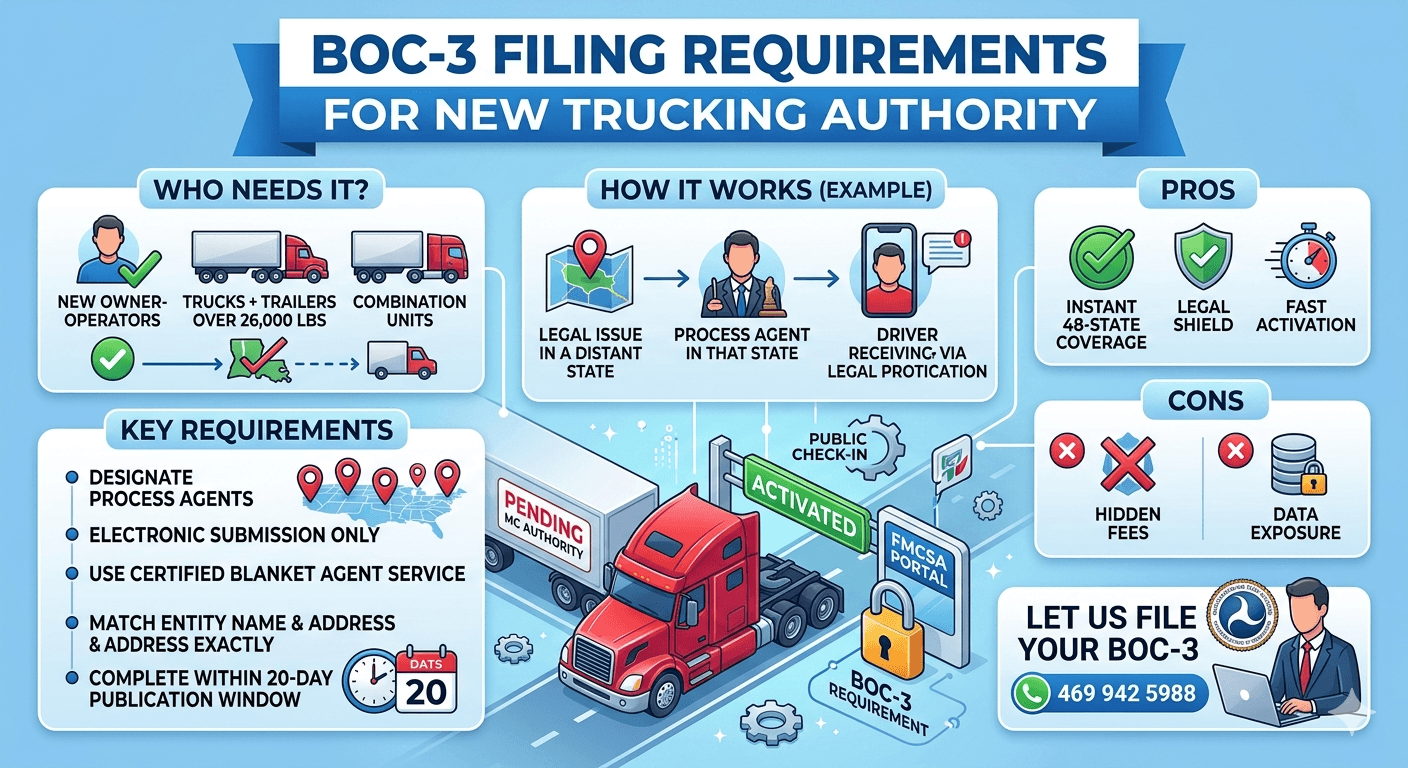
- Electronic Submission Only: The FMCSA no longer accepts paper mailings from carriers for this specific requirement. Your filing must be uploaded digitally through the automated licensing and insurance (L&I) system.
- Authorized Filing Entities Only: You cannot log into the FMCSA portal and upload your own BOC-3 form. The filing must be submitted directly by a certified, blanket process agent service company on your behalf.
- Perfect Entity Matching: The company name, physical address, and MC/USDOT numbers on the legal document must match your federal registry exactly. A single typo or abbreviation discrepancy will cause the system to reject the submission, delaying your activation window.
- The 20-Day Window: Once your application for operating authority is published in the FMCSA register, you have exactly 20 days to complete your filing alongside your liability insurance submissions.
Pros and Cons of Process Agent Blanket Coverage
Understanding the strategic leverage of using a centralized blanket service company vs. fragmented localized agents is critical for cost management.
The Pros
- Instant, Complete Compliance: A blanket service provider automatically covers all 48 states instantly under one corporate umbrella. You do not have to hunt down and pay 48 individual attorneys across the country.
- Administrative Shielding: If a legal dispute or property damage claim occurs in a distant state, the legal paperwork goes to the process agent first. This prevents server agents from showing up at your private home or dispatch office in front of customers.
- Speed to Market: Digital filings through certified blanket companies process inside the FMCSA database within hours, expediting the removal of your pending authority status.
The Cons
- Ongoing Overhead Risks: Many low-cost entry services charge cheap upfront fees but bury massive hidden costs in the fine print, such as charging exorbitant fees just to forward a piece of mail to your office.
- Data Vulnerability: If you use a non-vetted agency to handle your registration records, your private corporate structure and contact points can be exposed to aggressive telemarketing loops.
Real-Time Execution Example
To see how this legal safety net functions on the highway, review this operational scenario:
The Setup: An owner-operator based out of Georgia secures their interstate authority, uses an approved blanket service provider to satisfy their registration requirement, and books a high-paying load headed into Ohio. The Incident: While offloading freight at a receiver's facility in Ohio, a property damage dispute occurs. The receiver decides to file a small claims lawsuit against the Georgia-based trucking company. The Execution: Instead of trying to locate the driver in Georgia, the receiver's legal team checks the public FMCSA registry, finds the designated Ohio process agent linked to the carrier's MC number, and serves the legal paperwork directly to that physical Ohio address. The process agent scans the legal notice and sends it securely to the owner-operator within 24 hours, keeping the carrier fully compliant with court timelines without disrupting active asset movements.
Avoid Common Compliance Traps
New entrants frequently stumble during this phase, causing unexpected operational downtime. The most frequent errors include:
- Name Mismatches: If your corporate filing says "Logistics LLC" but your insurance or BOC-3 application states "Logistics Incorporated," the federal system blocks automation. Ensure your corporate EIN number and corporate records are uniform.
- Failing to Track Infrastructure Overlap: Your filing works in tandem with your insurance filings. If your insurance broker submits your policy forms but your agent hasn't submitted your form, your active status stays frozen. You must manage both pipelines simultaneously.
Get Activated Immediately: Let Our Experts File Your BOC-3
You did not launch a transportation company to lose precious time navigating government submission forms and tracking down out-of-state process agents.
At Trucking Help Center, we have a dedicated compliance team that specializes in setting up new authorities cleanly. We verify your corporate information, execute your filing directly within the FMCSA database, and ensure your system updates immediately. We can manage your complete BOC-3 filing setup and show you how to file a BOC-3 for your MC authority with zero processing delays.
Complete Operational Support for New Fleets
Once your authority is active, we provide the elite operational infrastructure required to scale your business and protect your cash flow:
- Automated Operational Tracking: Deploy TruckMate, engineered by our founder Zeshan Danish, to easily track your real-time trucking Cost Per Mile (CPM) alongside your revenue metrics inside one mobile system.
- Elite Freight Dispatching: Avoid predatory broker margins on the spot market. Our dispatch division secures top-dollar freight, handles broker packets, and monitors credit scores so you never face a broker not paying for a load crisis. We offer clear, carrier-first corporate pricing at a $250 flat weekly rate or a 5% per load managed structure.
Activate Your Authority Today
Do not allow administrative filing backlogs to park your equipment. Let our professional team handle the paperwork so you can focus entirely on scaling your fleet's revenue lines.
Contact Our Experts:
- Call/Text: 469-942-5988
- Email: Send your pending registration info or MC letter directly to support@truckinghelpcenter.com
- Review Operational Blueprints: Learn the exact execution steps to secure your business long-term by studying our comprehensive blueprint on how to become a successful owner-operator.