
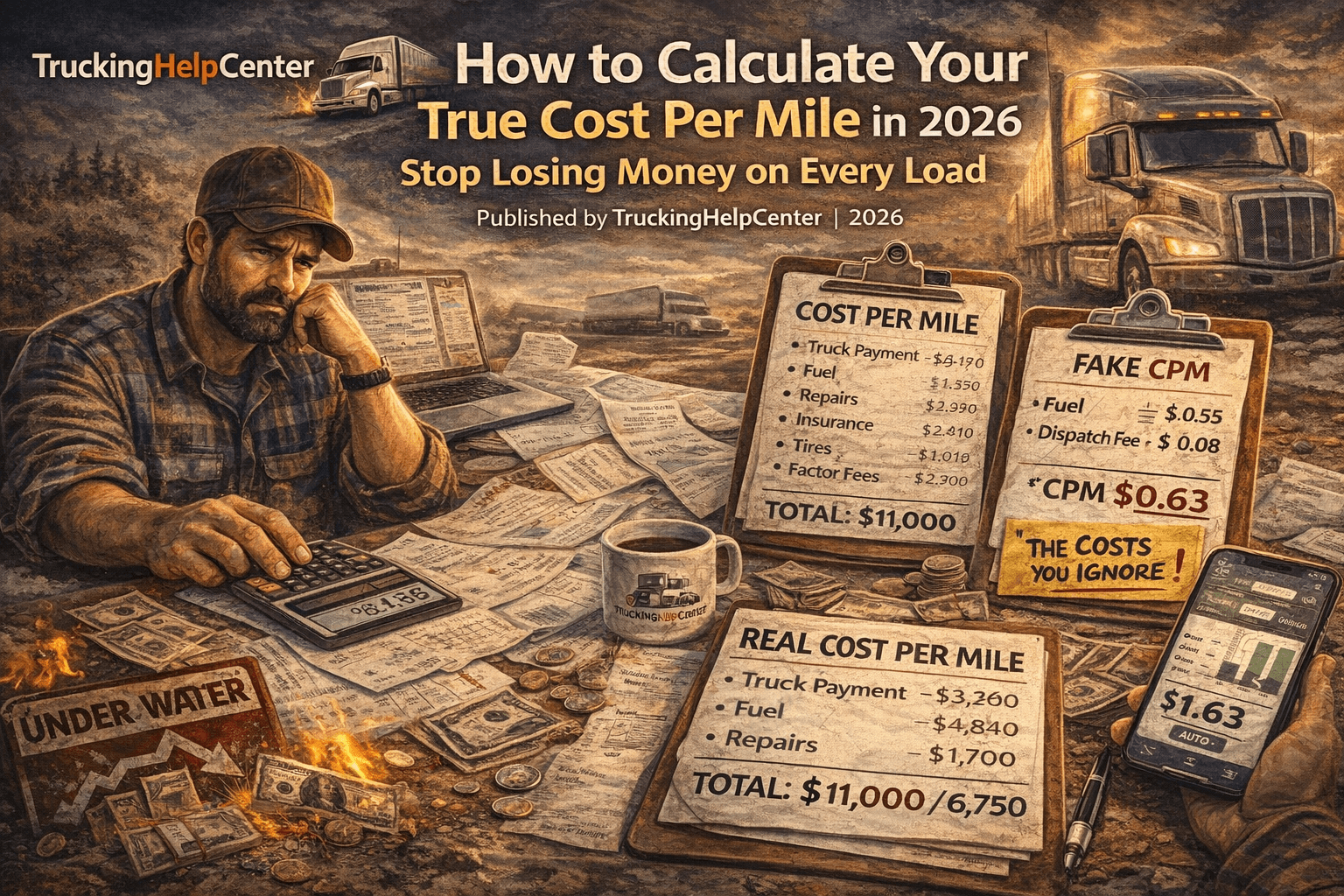
How to Calculate Your True Cost Per Mile in 2026: Stop Losing Money on Every Load
Published by Trucking Help Center | 2026
Most owner-operators don’t fail because rates are “too low.” They fail because they don’t know what it actually costs them to run their truck.
If you don’t know your true cost per mile (CPM), here’s the uncomfortable reality:
You are gambling on every load you accept.
And casinos are designed for one side to win — not you.
This article will show you:
- What true CPM really means in 2026
- Why most drivers calculate it wrong
- How CPM quietly destroys otherwise “busy” operations
- And how to calculate your real number — not a fantasy one No motivation. No hype. Just math.
First: Let’s Kill the Biggest Lie in Trucking
“I need at least $2.50 a mile to be profitable.”
That statement is meaningless without context.
There is no universal good CPM. Anyone selling you one is either lazy or lying.
Your CPM depends on:
- Your truck
- Your lanes
- Your deadhead
- Your discipline
- Your decisions
Two drivers running the same rate per mile can have completely different outcomes — one profitable, one bankrupt.
Rate Per Mile vs Cost Per Mile (The Confusion That Kills Businesses)
Let’s be clear:
- Rate per mile = what the broker pays you
- Cost per mile = what it actually costs you to move the truck
Most drivers focus obsessively on the first and guess the second.
That’s backwards.
If your cost per mile is $1.95 and you’re hauling $2.10 freight, you are:
- Burning time
- Burning equipment
- Burning yourself out
- For pennies — or losses you don’t see yet
Why Most CPM Calculations Are Wrong
Most drivers calculate CPM like this:
Fuel
- Dispatch fee = CPM That’s not CPM. That’s denial.
Costs drivers routinely ignore:
- Maintenance reserves
- Tires
- Oil & fluids
- Breakdowns
- Insurance increases
- Permits & compliance
- Downtime
- Factoring fees
- Interest
- Depreciation
- Deadhead miles
- Time (yes, time matters) Ignoring these doesn’t make them go away. It just delays the damage.
The Only CPM Formula That Matters
Here is the real formula:
True Cost Per Mile =
(Total Monthly Operating Costs) ÷ (Total Miles Driven, Including Deadhead)
Not revenue miles. All miles.
If you don’t include deadhead, your CPM is fiction.
Step-by-Step: How to Calculate Your True CPM in 2026
Step 1: Calculate Monthly Fixed Costs
These exist whether you move or not. Truck payment or lease
- Insurance
- Plates & permits
- Accounting / compliance
- ELD / subscriptions
- Phone & software
Example: Fixed costs = $3,200/month
Step 2: Calculate Variable Costs (Monthly Average)
These scale with miles.
- Fuel
- Maintenance & repairs
- Tires
- DEF
- Tolls
- Dispatch fees
- Factoring fees
Example: Variable costs = $7,800/month
Step 3: Total Monthly Operating Cost
Fixed + Variable $3,200 + $7,800 = $11,000
Step 4: Count ALL Miles
- Loaded miles
- Deadhead miles
- Miles chasing freight
- Miles repositioning
Example: Total miles = 9,000
Step 5: Your True CPM
$11,000 ÷ 9,000 = $1.22 CPM
That is your break-even number.
Anything below it:
- Loses money
Anything barely above it:
- Buys stress, not profit
The CPM Reality Check Most Drivers Avoid
Now ask yourself:
- Do you know your CPM by lane?
- Do you know how deadhead changes it?
- Do you know which brokers destroy your margins?
- Do you know which weeks you actually profited?
If the answer is no, your truck is not a business. It’s a hustle.
Why “Staying Busy” Is One of the Most Expensive Mistakes in Trucking
Busy does not mean profitable.
Drivers destroy themselves by:
- Taking cheap freight to avoid downtime
- Running bad lanes repeatedly
- Trusting brokers with poor payment history
- Letting dispatchers chase volume, not margin
Running more miles at bad CPM doesn’t fix the problem. It accelerates it.
CPM Is Not a Goal — It’s a Filter
You don’t chase CPM. You use it to reject bad decisions.
Before booking a load, you should know:
- Will this beat my CPM after deadhead?
- Is this broker reliable?
- Does this lane set me up for the next load?
If the answer isn’t clear, the answer is no.
Why Trucking Help Center Exists (And Why the THC App Matters)
Most drivers were never given:
- Real CPM education
- Broker transparency
- Payment history
- A simple way to track reality
That’s the gap Trucking Help Center exists to fill.
The upcoming THC app is being built to help drivers:
- Track real operating costs
- Monitor CPM automatically
- Verify brokers before hauling
- Spot patterns that hurt profitability
- Make decisions based on data — not hope
No subscriptions. No gimmicks. Built for drivers who want to survive long-term.
Disclaimer: This guide provides general information based on current market conditions. Individual circumstances vary. Always consult with your accountant, attorney, or business advisor for decisions affecting your operation. Market rates fluctuate—verify current data before negotiating.
Published by Trucking Help Center (THC)
Empowering owner-operators with real information from real drivers.