
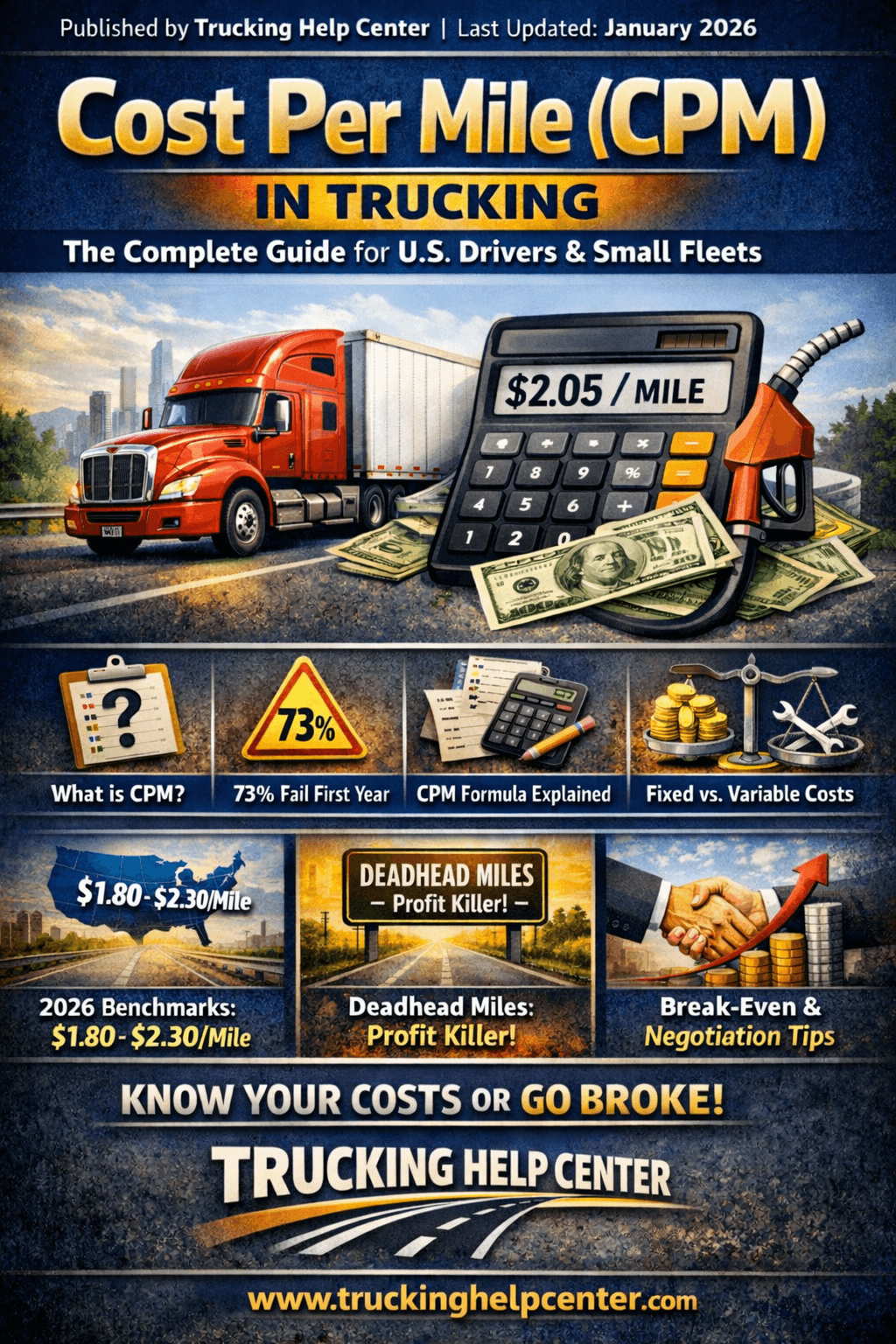
Cost Per Mile (CPM) in Trucking: The Complete Guide for U.S. Drivers & Small Fleets
Published by Trucking Help Center | Last Updated: January 2026
Table of Contents
- What is Cost Per Mile (CPM)?
- Why 73% of Owner-Operators Fail in Their First Year
- The CPM Formula (Stop Guessing, Start Calculating)
- Fixed Costs vs. Variable Costs: Know the Difference or Go Broke
- 2026 Industry Benchmarks: Where Do You Stand?
- The Deadhead Mile Trap (And How It's Killing Your Profit)
- How to Calculate Your Break-Even Rate
- Negotiating with Brokers: Using CPM as Your Weapon
- Fuel Cost Management: Your Biggest Variable Enemy
- Maintenance Reserves: The $15,000 Mistake You Can't Afford
- Real-World CPM Examples (Class 8 Tractors)
- CPM Calculators and Tools
- Frequently Asked Questions
What is Cost Per Mile (CPM)? {#what-is-cpm}
Cost Per Mile (CPM) is the total amount it costs you to operate your commercial truck for one mile. This includes every expense—fuel, insurance, maintenance, driver wages, truck payments, permits, and even the coffee you buy at the truck stop if it's a business expense.
CPM is not an accounting gimmick. It's the difference between running a profitable trucking business and slowly bleeding money while convincing yourself you're "making it."
The Brutal Truth
If you don't know your CPM down to the penny, you are not running a business. You're operating an expensive hobby that will bankrupt you within 18 months.
Industry Reality Check (2026):
- Average CPM for owner-operators: $1.80–$2.30 per mile
- Average load rate offered by brokers: $1.85–$2.50 per mile
- Your margin for error: Razor-thin to nonexistent
If you're accepting loads at $2.00/mile and your CPM is $1.95/mile, you're making $25 profit on a 500-mile haul. That's $5/hour before taxes. You'd make more working at Costco with health benefits.
Why 73% of Owner-Operators Fail in Their First Year {#why-operators-fail}
According to FMCSA data and industry analysis, nearly 3 out of 4 new owner-operators shut down within 12 months. Here's why:
The Fatal Mistakes
-
They Don't Know Their CPM
They chase "high-paying" loads without understanding their real costs. A $3.00/mile load with 300 deadhead miles can lose money. -
They Treat the Truck Like a Job, Not a Business
Employees get paid when things break. Business owners eat the repair bill and still have to make the truck payment. -
They Have No Cash Reserves
The transmission fails. $8,000 repair. No emergency fund. Game over. -
They Accept Losing Loads Because "It's Better Than Nothing"
Wrong. Running a load below your CPM costs you money. Sitting still costs less. -
They Let Brokers Set Their Rates
If you don't know your walk-away number, every negotiation is stacked against you.
The Hard Math
Scenario: Owner-operator with $1.90 CPM accepts a load paying $1.85/mile for 1,000 miles.
- Revenue: $1,850
- Actual Cost: $1,900
- Loss: -$50
Now multiply that by 3 loads per week. You're losing $600/month while working 70-hour weeks. Within six months, you're behind on truck payments. By month 10, the bank repossesses your truck.
This is not a horror story. This is the industry standard for operators who don't know their numbers.
The CPM Formula (Stop Guessing, Start Calculating) {#cpm-formula}
Basic Formula
Total Monthly Expenses ÷ Total Monthly Miles = Cost Per Mile (CPM)
The Complete Formula (What You Actually Need)
(Fixed Costs + Variable Costs) ÷ (Loaded Miles + Deadhead Miles) = True CPM
Why "Total Miles" Matters
Loaded Miles: Miles you're paid to drive
Deadhead Miles: Unpaid miles (driving to pickup, returning empty)
If you only calculate CPM based on loaded miles, you're lying to yourself. The truck burns fuel and wears down whether you're loaded or empty.
Monthly Calculation Example
Total Expenses: $9,500
Loaded Miles: 8,000
Deadhead Miles: 2,000
Total Miles: 10,000
CPM = $9,500 ÷ 10,000 = $0.95 per mile
Wait—that seems low compared to industry averages, right?
That's because we haven't included driver pay yet. Keep reading.
Fixed Costs vs. Variable Costs: Know the Difference or Go Broke {#fixed-vs-variable}
Fixed Costs (The "Sit Still" Bills)
These costs hit you whether the wheels turn or not.
| Expense | Monthly Cost (2026 Average) |
|---|---|
| Truck Payment (Financed) | $1,800–$2,500 |
| Trailer Payment | $400–$800 |
| Insurance (Liability, Physical Damage, Cargo) | $1,200–$2,000 |
| Permits & Plates (IRP, IFTA, 2290) | $100–$300 (amortized monthly) |
| ELD Subscription | $30–$60 |
| Dispatch/Load Board Fees | $50–$200 |
| Accounting/Bookkeeping | $100–$300 |
| Health Insurance (Owner-Operator) | $500–$1,200 |
Total Fixed Costs: $4,180–$7,360/month
Variable Costs (The "Rolling" Bills)
These scale with miles driven.
| Expense | Cost Per Mile (2026 Average) |
|---|---|
| Fuel (at $3.50/gallon, 6.5 MPG) | $0.54/mile |
| Maintenance & Repairs | $0.15–$0.20/mile |
| Tires | $0.04–$0.06/mile |
| Driver Pay (If Paying Yourself) | $0.50–$0.70/mile |
| Factoring Fees (2–4% of load value) | $0.04–$0.10/mile |
| Tolls (Regional) | $0.02–$0.05/mile |
Total Variable Costs: $1.29–$1.65/mile
The Combined Reality
Example Operator Running 10,000 Miles/Month:
- Fixed Costs: $5,500
- Variable Costs: $1.47/mile × 10,000 = $14,700
- Total Monthly Expenses: $20,200
- CPM: $20,200 ÷ 10,000 = $2.02/mile
Now add 20% profit margin: $2.02 × 1.20 = $2.42/mile minimum rate
If you're booking loads under $2.42/mile, you're either not paying yourself or slowly going bankrupt.
2026 Industry Benchmarks: Where Do You Stand? {#industry-benchmarks}
Owner-Operator CPM Ranges (Class 8, Dry Van/Reefer)
| Operation Type | CPM Range |
|---|---|
| Lease-Purchase (New Truck) | $2.10–$2.50 |
| Financed Truck (3–5 years old) | $1.85–$2.20 |
| Paid-Off Truck | $1.30–$1.70 |
| Company Driver (For Comparison) | N/A (Paid per mile, not CPM) |
Small Fleet (2–5 Trucks) CPM
| Cost Category | Per Truck CPM |
|---|---|
| With Employed Drivers | $1.90–$2.40 |
| With Owner-Operators Leased On | $1.60–$2.00 |
Regional Variations
Higher CPM Markets:
- California: +$0.15–$0.25 (fuel, insurance, regulations)
- Northeast Corridor: +$0.10–$0.20 (tolls, urban congestion)
Lower CPM Markets:
- Texas, Midwest: Baseline
- Southeast: -$0.05–$0.10 (lower insurance, fuel costs)
The Deadhead Mile Trap (And How It's Killing Your Profit) {#deadhead-trap}
Deadhead miles are the silent assassin of trucking profitability.
The Deceptive Load Scenario
Broker Offer:
$2.80/mile for 600 loaded miles = $1,680
Sounds great, right?
The Reality:
- Current location to pickup: 250 miles (deadhead)
- Loaded miles: 600
- Delivery to next load: 150 miles (deadhead)
- Total miles: 1,000
True Rate: $1,680 ÷ 1,000 = $1.68/mile
If your CPM is $1.90, you just lost $220 on a "high-paying" load.
The Deadhead Formula
Total Pay ÷ (Loaded Miles + Deadhead Miles) = Effective Rate Per Mile
Industry Deadhead Averages
- National Average: 15–20% deadhead
- Poor Planning: 25–35% deadhead
- Optimized Operations: 8–12% deadhead
Example Impact on 10,000 Monthly Miles:
| Deadhead % | Paid Miles | Unpaid Miles | Impact on Revenue |
|---|---|---|---|
| 10% | 9,000 | 1,000 | Baseline |
| 20% | 8,000 | 2,000 | -$2,500/month @ $2.50/mile |
| 30% | 7,000 | 3,000 | -$5,000/month @ $2.50/mile |
How to Minimize Deadhead
- Pre-plan your next load before delivery
- Use load boards with "backhaul" filters
- Build relationships with shippers in your delivery areas
- Accept slightly lower rates for immediate pickup vs. deadheading 200 miles
- Use the Trucking Help Center app (coming soon) for real-time load matching
How to Calculate Your Break-Even Rate {#break-even-rate}
Your break-even rate is the minimum per-mile rate you must charge to cover all costs without profit.
Formula
Break-Even Rate = CPM ÷ (1 - Deadhead %)
Example
Your CPM: $1.90
Average Deadhead: 15%
$1.90 ÷ (1 - 0.15) = $1.90 ÷ 0.85 = $2.24/mile
This is your floor. Any load under $2.24/mile loses money.
Your Target Rate (With Profit)
Add your desired profit margin (15–25% is standard).
Target Rate = Break-Even Rate × (1 + Profit Margin)
Example with 20% profit:
$2.24 × 1.20 = $2.69/mile
This is your walk-away number. If the broker won't meet it, hang up.
Negotiating with Brokers: Using CPM as Your Weapon {#negotiating-brokers}
The Broker's Playbook
Brokers make money on margin—the difference between what the shipper pays and what you accept. Their goal is to pay you as little as possible while keeping the load moving.
Common Broker Lines:
- "That's all the money in the load"
- "We're losing money at this rate"
- "I've got 10 other trucks calling me"
- "Rates are soft right now, that's the market"
Your Counter-Playbook (The CPM Negotiation Script)
Broker: "I can do $2.10/mile for 500 miles, that's $1,050."
You: "Let me break down my numbers. My operating cost is $1.95/mile. At $2.10, I'm making $75 gross profit on this load. That's $0.15/mile, or $7.50/hour before taxes for 10 hours of work. My time and equipment are worth more than that. I need $2.60/mile to move this freight."
Broker: "I can't do $2.60, that's way too high."
You: "What can you do?"
Broker: "I can go to $2.35."
You: "I'll take it at $2.45 and we have a deal right now."
Broker: "Let me check with the shipper... okay, I can do $2.40."
You: "Done. Send the rate confirmation."
Why This Works
- You led with data, not emotion
- You showed the broker you know your numbers
- You negotiated from a position of knowledge
- You were willing to walk away
When to Walk Away
If the broker won't budge and the rate is below your break-even, walk away.
Sitting still costs less than losing money on a load.
Fuel Cost Management: Your Biggest Variable Enemy {#fuel-management}
Fuel typically represents 30–40% of your total operating costs. Small changes create massive impacts.
2026 Fuel Economics
National Average Diesel Price: $3.50/gallon
Average Truck MPG: 6.0–7.0 MPG
Cost Per Mile (at 6.5 MPG): $0.54/mile
The MPG Impact Chart
| MPG | Cost Per Mile @ $3.50/gal | Monthly Cost (10,000 miles) | Annual Difference vs. 6 MPG |
|---|---|---|---|
| 5.5 | $0.64 | $6,400 | -$14,400/year |
| 6.0 | $0.58 | $5,833 | -$7,200/year |
| 6.5 | $0.54 | $5,385 | Baseline |
| 7.0 | $0.50 | $5,000 | +$4,620/year |
| 7.5 | $0.47 | $4,667 | +$8,616/year |
Improving from 6.5 to 7.5 MPG saves you $8,616 annually. That's real profit.
How to Improve MPG (Real Strategies, Not Fantasy)
- Maintain Optimal Speed: 62–65 MPH is the sweet spot
- Use Cruise Control: Reduces throttle fluctuations
- Reduce Idling: Every hour of idle = 0.8 gallons ($2.80)
- Proper Tire Inflation: Under-inflation kills 0.3–0.5 MPG
- Regular Maintenance: Clean air filters, quality oil
- Route Planning: Avoid mountains when possible
- Reduce Weight: Every 1,000 lbs = -0.1 MPG
Fuel Card Programs (Stop Paying Retail)
| Program | Average Savings | Network Size |
|---|---|---|
| EFS | $0.05–$0.15/gallon | 6,000+ locations |
| Comdata | $0.07–$0.18/gallon | 5,500+ locations |
| TCS | $0.10–$0.20/gallon | 1,200+ locations |
| Pilot/Flying J Fleet Card | $0.08–$0.15/gallon | 750+ locations |
Fuel savings on 10,000 miles/month (1,538 gallons):
$0.10/gallon discount = $154/month = $1,848/year
Maintenance Reserves: The $15,000 Mistake You Can't Afford {#maintenance-reserves}
The Maintenance Disaster Scenario
Month 1–6: Everything runs fine. You pocket the full revenue.
Month 7: Transmission failure. $8,500 repair.
Month 8: Still recovering from transmission. Driveshaft issues. $1,200.
Month 9: Truck payment bounces. Credit score tanks. Bank calls.
Month 10: Repossession notice.
This happens to operators who don't reserve maintenance money.
The Maintenance Reserve Formula
Monthly Maintenance Reserve = (Annual Maintenance Cost ÷ 12) + Emergency Buffer
2026 Maintenance Costs (Class 8, 100,000 miles/year)
| Category | Annual Cost | Cost Per Mile |
|---|---|---|
| Routine Maintenance (Oil, Filters) | $3,500–$5,000 | $0.035–$0.050 |
| Tires (Full Set Every 150k miles) | $2,667 (amortized) | $0.027 |
| Brakes | $2,000–$3,000 | $0.020–$0.030 |
| Major Repairs (Transmission, Engine, Differential) | $4,000–$8,000 | $0.040–$0.080 |
| TOTAL | $12,167–$18,667 | $0.122–$0.187 |
Recommended Reserve: $0.15–$0.20 Per Mile
Monthly Reserve (10,000 miles/month):
$0.15 × 10,000 = $1,500/month
Annual Reserve:
$1,500 × 12 = $18,000
Where to Keep This Money
Do NOT mix it with operating capital.
- Separate Business Savings Account
- High-Yield Money Market (4–5% APY)
- Mark it "MAINTENANCE ONLY" and do not touch it
The Alternative (Don't Do This)
You can choose not to reserve maintenance money. When the engine blows ($25,000 rebuild), you'll have three options:
- Pay cash (you don't have)
- Finance the repair at 18% APR
- Park the truck and default on payments
All three options lead to bankruptcy.
Real-World CPM Examples (Class 8 Tractors) {#real-world-examples}
Example 1: The Struggling Lease-Purchase Operator
Truck: 2024 Freightliner Cascadia (Leased)
Miles/Month: 8,000
Deadhead: 25%
Fixed Costs:
- Lease Payment: $2,200
- Insurance: $1,800
- Permits: $150
- Health Insurance: $600
- ELD/Software: $50
- Total Fixed: $4,800
Variable Costs:
- Fuel (5.8 MPG, $3.50/gal): $0.60/mile
- Maintenance Reserve: $0.15/mile
- Tires: $0.05/mile
- Driver Pay (Self): $0.60/mile
- Factoring (3%): $0.08/mile
- Total Variable: $1.48/mile × 8,000 = $11,840
Total Monthly Costs: $4,800 + $11,840 = $16,640
CPM: $16,640 ÷ 8,000 = $2.08/mile
Break-Even Rate (with 25% deadhead):
$2.08 ÷ 0.75 = $2.77/mile
Current Average Rate Acceptance: $2.30/mile
Monthly Loss: ($2.77 - $2.30) × 6,000 loaded miles = -$2,820/month
This operator will be bankrupt within 6 months.
Example 2: The Smart Owner (Paid-Off Truck)
Truck: 2019 Kenworth T680 (Owned Outright)
Miles/Month: 10,000
Deadhead: 12%
Fixed Costs:
- Truck Payment: $0
- Insurance: $1,400
- Permits: $150
- Health Insurance: $700
- ELD/Software: $50
- Total Fixed: $2,300
Variable Costs:
- Fuel (7.2 MPG, $3.40/gal): $0.47/mile
- Maintenance Reserve: $0.18/mile
- Tires: $0.04/mile
- Driver Pay (Self): $0.65/mile
- Total Variable: $1.34/mile × 10,000 = $13,400
Total Monthly Costs: $2,300 + $13,400 = $15,700
CPM: $15,700 ÷ 10,000 = $1.57/mile
Break-Even Rate (with 12% deadhead):
$1.57 ÷ 0.88 = $1.78/mile
Target Rate (25% profit):
$1.78 × 1.25 = $2.23/mile
Current Average Rate Acceptance: $2.60/mile
Monthly Profit: ($2.60 - $1.78) × 8,800 loaded miles = $7,216/month
Annual Profit: $7,216 × 12 = $86,592/year
This operator is building wealth.
The Difference
Same industry. Same roads. One is going bankrupt, one is making $86k/year in profit.
The difference? One knows his CPM and negotiates accordingly. The other accepts whatever brokers offer.
CPM Calculators and Tools {#cpm-tools}
Free Online Calculators
-
ATBS Cost Per Mile Calculator
https://www.atbsshow.com/cost-per-mile-calculator/ -
OOIDA CPM Spreadsheet
https://www.ooida.com/members-only/tools/ -
Trucking Help Center CPM Calculator (Coming Soon)
Direct integration with ELDs and fuel cards for real-time CPM tracking
Recommended Software
| Software | Purpose | Cost |
|---|---|---|
| QuickBooks Self-Employed | Expense tracking, mileage | $15/month |
| Rigbooks | Trucking-specific accounting | $30/month |
| TruckLogics | IFTA, dispatching, invoicing | $25/month |
| Axon Trucking Software | Fleet management | $40/month |
Trucking Help Center App (Coming 2026)
Revolutionary Features:
- Real-time CPM dashboard (ELD + fuel card integration)
- Color-coded load board (Red = below your CPM, Green = profitable)
- Direct shipper connections (cut out broker margins)
- One-tap roadside assistance
- Automated IFTA reporting
Frequently Asked Questions {#faq}
What is a good CPM for an owner-operator in 2026?
Answer: $1.80–$2.30 depending on your equipment financing status. If you own your truck outright, $1.30–$1.70 is achievable. The real question is: what's YOUR CPM? Industry averages don't pay your bills.
How do I calculate CPM if I'm just starting?
Answer: Use industry benchmarks as a starting point, but within 30 days, you need actual data. Track every expense. Every. Single. One. Divide by total miles. That's your real CPM.
Should I include my salary in CPM calculations?
Answer: Absolutely. If you're not paying yourself at least $0.50–$0.70/mile, you're working for free. Your time has value. Factor it in.
What if my CPM is higher than the rates brokers are offering?
Answer: Then you have three choices:
- Negotiate better
- Find better freight
- Lower your costs (better fuel MPG, cheaper insurance, refinance truck)
If none of those work, you're in the wrong business or wrong market.
How often should I calculate my CPM?
Answer: Monthly at minimum. Weekly is better. The Trucking Help Center app will calculate it in real-time.
What's the biggest mistake new owner-operators make with CPM?
Answer: They calculate it once and never update it. Fuel prices change. Maintenance costs spike. Insurance renews at a higher rate. Your CPM is a living number. Treat it that way.
Can I run profitably with a CPM of $2.50?
Answer: Yes, but you need to book loads at $3.00–$3.25/mile consistently. That's possible in specialized freight (hazmat, oversized, refrigerated high-value), but rare in dry van.
How do I reduce my CPM?
Answer:
- Improve fuel efficiency (biggest impact)
- Pay off your truck (eliminates largest fixed cost)
- Shop insurance annually (can save $200–$500/month)
- Reduce deadhead miles (better load planning)
- Do preventive maintenance (cheaper than emergency repairs)
Is CPM the same as "all-in cost"?
Answer: Yes. CPM should include EVERYTHING. If you're spending money because you own a truck, it goes in the CPM calculation.
What CPM do mega carriers operate at?
Answer: $1.20–$1.60/mile due to economies of scale, bulk fuel discounts, negotiated maintenance rates, and self-insurance. You can't compete with them on price. Compete on service and flexibility.
Final Word: The CPM Commandment
If you remember nothing else from this guide, remember this:
Know your CPM. Calculate it monthly. Never accept a load below your break-even rate. Negotiate from data, not desperation.
The trucking industry doesn't reward hard work. It rewards smart work. You can drive 70 hours a week and go bankrupt if you don't know your numbers.
Your CPM is your business IQ. Master it or the industry will eat you alive.
About Trucking Help Center
Trucking Help Center exists to end the era of brokers exploiting owner-operators who don't know their numbers. We're building technology that puts power back in the hands of drivers—real-time CPM tracking, direct shipper connections, and transparent freight rates.
The old game is rigged. We're building a new one.
Questions? Comments? Need help calculating your CPM?
Contact us: support@truckinghelpcenterlive.com
Disclaimer: This guide provides educational information based on 2026 industry data. Actual costs vary by region, equipment, and operation type. Consult with a qualified accountant or business advisor for personalized financial guidance.
© 2026 Trucking Help Center. All rights reserved.